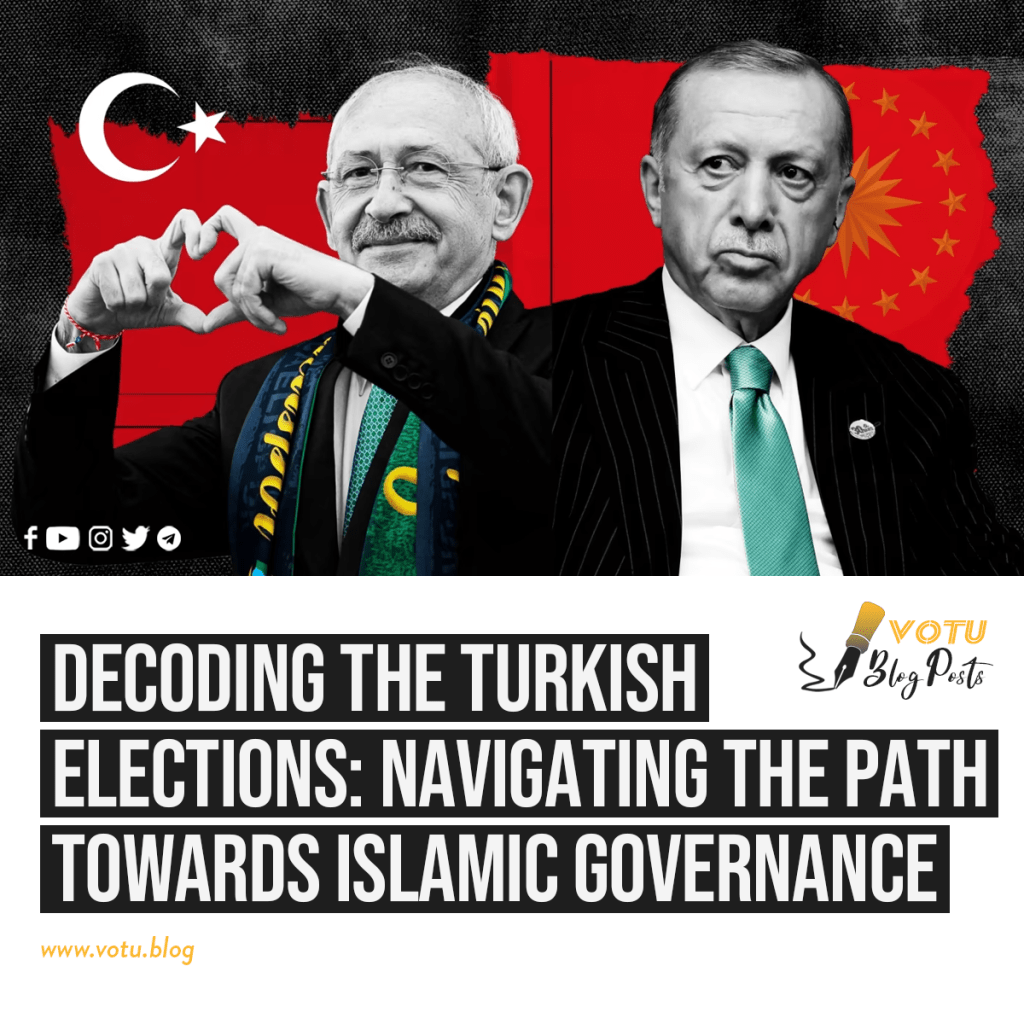
The Turkish elections held on May 14, 2023, have unfolded amidst a backdrop of Western capitalism and democracy, which do not align with Shari’ah. As Muslims, it is crucial for us to examine these political developments through the lens of Islam and explore the implications for Turkey and the wider Muslim community. Let’s delve into the key highlights and factors shaping the political landscape in Turkey from an Islamic perspective.
- Western Interference and Opposition’s Agenda:
It is no secret that Western powers have been actively involved in supporting the Turkish opposition, aiming to thwart President Erdogan’s pursuit of political independence and his vision for economic growth and industrial development. As Muslims, we must recognize the risks posed by external interference and the potential impact on Turkey’s Islamic identity. - Media Campaigns and Allegations:
The media campaign against President Erdogan has intensified, with allegations ranging from corruption to inadequate disaster response. While it is essential to hold leaders accountable, we must remain vigilant about the biases embedded within these narratives and know that the enemies of Allah will always seek to disrupt developments that are not part of its vision for the Muslim world. - Utilizing Tragedy for Political Gains:
Tragedies such as the recent devastating earthquake have unfortunately become opportunities for political exploitation. The opposition has sought to undermine Erdogan’s economic efforts and shake public confidence in his leadership. As Muslims, we should prioritise the well-being of affected communities over political maneuvering during times of crisis. - The Opposition Coalition and Key Figures:
Understanding the opposition coalition, including figures like Kilicdaroglu, is crucial for Muslims who seek to evaluate the potential impact on Turkey’s Islamic governance. We must critically analyze and challenge their proposed policies and ideologies, ensuring they align with Islam. - Diplomatic Relations and International Dynamics:
Erdogan’s campaign has emphasised achievements in the energy and diplomatic sectors, but we must carefully examine the implications of Turkey’s foreign relations from an Islamic perspective. Erdogan’s campaign has emphasised achievements in the energy and diplomatic sectors, but we must carefully examine the implications of Turkey’s foreign relations from an Islamic perspective. As Muslims, we should remember that our foreign relations are to liberate the rest of the world with Islam. Our diplomacy is not limited by area and will always be to benefit the Muslim Ummah widely. The energy sector will be tipped on its head when it no longer is in the hands of capitalist corporations but in the hands of the State that will use it to firstly benefit the Muslims and secondly to leverage it against opposing powers as a bargaining tool. - Muslim Engagement and Unity:
These elections hold great importance for Muslims as they provide an opportunity to engage in a critical discussion about the choice between Islamic governance and secularism. If the people voice their support for Islamic principles and reject Western-style democracy, it can challenge political parties advocating for secularism as the solution for Muslim governance. This confirms the need for the Ummah to re-establish Khilafah.
The Turkish elections are not simply political events; they carry profound implications. As Muslims, we should actively participate in the political discourse, critically analyze narratives, and support only those ideas that align with Islam. Through the Ummah’s comprehension of political occurrences and the enhancement of their political awareness, they become less susceptible to the snares laid out by the Kuffar. It is crucial for Muslims to recognize that politics and Islam are inherently interconnected and cannot be separated, regardless of the adversaries’ efforts to do so.

 Voice Of The Ummah
Leave a comment