
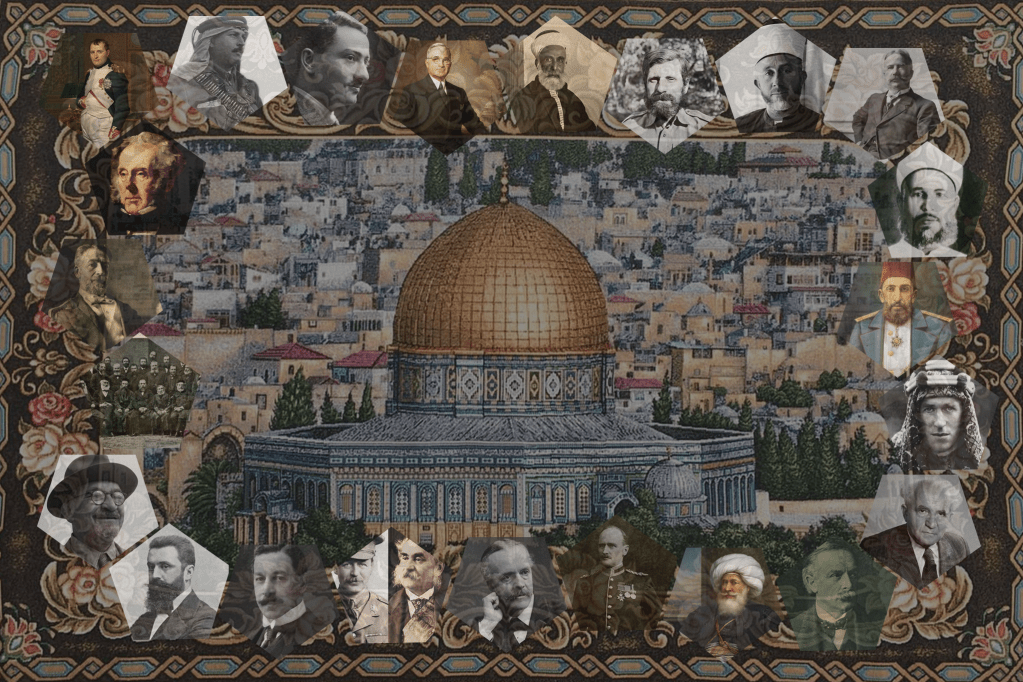
On the anniversary of the fall of Jerusalem on 11th December 1917, which resulted in the Ottomans losing control of Jerusalem to the British, it seems fitting to address what the history was that led to this fall. The loss of not only Jerusalem, but of Palestine as a whole, is something the Muslims have never recovered from and still suffer the catastrophic consequences of even today.
Since ‘Israel’s’ ongoing systematic genocide in Gaza which began 65 days ago, many questions have once again arisen as to what the origins are of the Israeli-Palestinian conflict. Some proclaim that this all began on October 7th, whereas others argue that the problem began after the six-day war in 1967, which resulted in ‘Israel’ occupying the whole of Palestine. In contrast, there are others who say that the issues all started 75 years ago with the establishment of the state of ‘Israel’ in 1948, whilst others point to the 1917 Balfour Declaration. However, a closer look at history makes it glaringly obvious that although all these events are undeniably significant, they are not singularly the origins of the conflict. Rather, the timeline of the origins of this conflict precedes any of the aforementioned points, with the roots found two centuries earlier in 1799. It is only once we study the very beginnings of this conflict and the subsequent events that occurred, which will give us a more complete understanding of how these historic events unfolded and how they are still shaping the present.
Before further exploring these origins, it is important to note that the fall of Jerusalem and indeed Palestine itself, did not occur in a vacuum, and thus cannot be viewed in isolation to the larger political landscape within which it once existed. Palestine was under the rule of the Ottoman Caliphate since the 16th century and remained so for more than 400 years. The Caliphate ruled large areas of the Middle East, Eastern Europe and North Africa for more than 600 years. The Ottoman state was a source of great regional stability and security, as well as being the catalyst for pivotal achievements in the arts, science, religion and culture.
The Western Europeans with their own colonialist ambitions viewed them as a threat and so in 1799 an army under Napoleon Bonaparte, who was commander of the French army, upon occupying Egypt also had his sights set on the rest of the Levant. Bonaparte was the first European monarch to occupy Egypt and reach the Holy Land after many failed attempts in previous centuries. He captured Haifa and then laid siege on Acre and although he ultimately failed in his attempt at seizing Acre, due to the strong resistance led by Ahmad Pasha Al Jazzar, it was during this attempt that the concept of bringing Jews to the Holy Land and establishing an entity for themselves officially emerged. Bonaparte, whilst in search of allies to seize Palestine and defeat the Ottomans issued a proclamation to the Jews inviting them to reclaim ancient Jerusalem under French protection, as the ‘rightful heirs of Palestine’. Although this aim failed at the time, what Bonaparte laid in motion was the renewed interest in the crusader past and reignited British interest in Palestine.
To demonstrate, in 1840, 41 years after Napoleon’s proclamation to the Jews, the British Foreign Secretary Lord Palmerston wrote a letter to his ambassador in Istanbul urging him to persuade the Sultan to open up Palestine and allow the Jews to migrate there for the benefits of increased wealth in the Sultan’s domain and a means to keep in check their common enemy, Muhammed Ali of Egypt who was a rising power at the time. And thus, as this seed had been sown in the minds of the Europeans, this colonial project continued years later with the convergence of interests of British imperialism and the Zionist movement.
With the secret plan of the Allied states during World War One, namely Britain and France with Russia also being privy to these discussions, devious agreements were made to carve up the Ottoman state. Whilst plotting this division and breakup of the Middle East, they were willing to do anything to make this happen. In line with this, the British on the one hand promised the Arabs independence in return for their support against the Ottoman state, whilst simultaneously also promising the Jews their own homeland in Palestine in return for hopes of leveraging their powerful influence in Russia and the US at the time. Notwithstanding the fact that Britain had also already agreed with France that Palestine would be internationalised. Britain’s ambitions were so far reaching that they were willing to make contradictory promises to different groups and nations so that they could enact their own imperialist interests, thus furthering their own dominance in the world. In so doing, the British paved the way for a legacy of bloodshed, forced expulsion and theft at the expense of the Palestinians.
Nonetheless, one must not overlook or downplay the essential groundwork that was already being laid down by the Zionists well before even the British promise of a Jewish homeland in Palestine. The Zionists had already been busy planning and making preparations by buying land and hence increasing Jewish immigration to Palestine as early as 1880. The Jews who faced the Pogroms in Russia in 1881 wanted to immigrate to Palestine and so they did with the help of wealthy benefactors like Baren Edmund de Rothschild. The Lovers of Zion movement gained momentum during this time, along with their ideas of Jewish nationalism and the idea of finding a home in the Ottoman state. Rothschild began visiting Palestine and spent over 14 million French Francs to establish 30 Jewish settlements.
One might question how this was possible when Palestine was still under the authority of the Ottomans? The answer to this is manifold, but suffice to say that big mistakes were made and despite efforts made by Sultan Abdul Hamid there was not enough action taken to halt or prevent the Jewish immigration to Palestine. The law of 1869 meant that foreigners were allowed to buy land in the Ottoman state, except for in the Hijaz. To prevent this law from being abused, in 1871 the Sultan declared 80% of Palestine as state land, nonetheless, this law was still deceptively exploited by the Jews using various methods which resulted in increased Jewish immigration to Palestine. It is also important to note that many of these immigrants belonged to the ‘Lovers of Zion’ movement, the Jewish nationalist group who were moving to Palestine for an ideological purpose. Upon witnessing this increase, in 1881 it was decreed that foreign Jews could immigrate to and settle anywhere within the Ottoman Empire, except in Palestine. In 1883 the Sultan also restricted the acquisition of Palestinian land and in 1900 he restricted the length of time Jewish pilgrims were allowed to stay in Palestinian territory to 30 days.
Sultan Abdul Hamid had foresight of the risks of allowing Jewish immigration into Palestine, so in 1891 he told the Military Supervisory Commission, ‘Granting the status of (Ottoman) subjects to these Jews and settling them is most harmful; and since it may in the future raise the issue of a Jewish government, it is imperative not to accept them’. However, despite this there were contradictory policies in place which were on the one hand meant to restrict Jewish immigration, settlement and land ownership, but in practice were allowing it with no enforcement or persecution for those who were breaking the rules, and with no threat of being sent back despite the decree of prohibiting migration to Palestine. This is another discussion in itself, but suffice to say that the result of all these discrepancies, led to this early Jewish colonisation of Palestine.
During this period Chaim Weizmann, who was a leading figure of the Zionists, also visited Palestine and established a company in Jaffa. He struck a deal with Rothschild where they set up the Jewish National Fund to buy land in Palestine. Expulsion of Palestinians from their land existed even this early on when the Jews bought 10,000 dunams in the Marj Bin Amer region of Palestine, which subsequently forced the 60,000 Palestinian farmers that were already living there, to leave. This catastrophe occurred decades before the well-known Nakba of 1948. Not only this, they set up a Jewish militia known as Hashomer to protect these ever-increasing Jewish settlements. Between 1883 and 1900, the total land purchased by the Jews was estimated to be 196,000 dunams and by 1908 this number increased significantly to 400,000 dunams. The Arabs, including the Palestinians were aware of Zionism and its racist motives to colonise their land and create a homeland for the Jewish people. This even led to some Palestinians forming a newspaper for instance to warn of how ‘The Jewish state would be a poisonous dagger in the heart of the Arabs’.
In 1896, Theodor Herzl published a pamphlet that came to be known as the ideological basis for political Zionism – ‘The Jewish State’. Herzl concluded in this that the solution to centuries-old anti-Semitism and attacks in Europe was the creation of a Jewish state. In this endeavour, two of their representatives had already been sent to Palestine to investigate the prospects of a Jewish state. Their report famously concluded that ‘the bride is beautiful, but she is married to another man’, the latter being the indigenous Palestinian population. Herzl openly lobbied towards his cause, trying to gain influential people onside. He even tried to bribe the Sultan in 1896 into giving him Palestine, to which he was told, ‘I cannot sell even a foot of land, for it does not belong to me, but to my people. My people have won this state by fighting for it with their blood and have fertilized it with their blood.’
Herzl was undeterred and continued in his mission. In 1902, Herzl met with then British Colonial Secretary Joseph Chamberlain and told him the Zionist base in Palestine would be a buffer state, securing British interests. He understood well that the Zionist project could never be successful without the sponsorship and protection of a major power, and thus had to act in the context of the interests of a major power such as Britain. The goal of this being to split the Ottoman state and to ensure Britain’s continued imperial dominance with Zionist Jews as their allies in the region, despite the fact that the Jewish community in Palestine by 1914 still only constituted barely 8% of the population.
With the onset of WW1, more opportunities to actually make this a reality began to emerge. In 1915, in a secret memorandum presented to the British Cabinet titled ‘The Future of Palestine’ drafted by Herbert Samuel, a British politician and committed Zionist. He advised that ‘the time was not right for the establishment of an autonomous Jewish state in Palestine’ and that rather, it should be annexed to the British empire as this would be ‘the most welcome solution to the supporters of the Zionist movement’. Furthermore, he shared his hope that under British authority, over time more Jews would settle in Palestine and grow into a majority. This recommendation was significant, as it was later taken into account in the 1916 Sykes-Picot agreement which carved the way towards the establishment of a Jewish state. In 1915, the same year as this recommendation, Sharif Hussein of Arabia was also making deals with the British to offer his military support against the Ottomans in return for their support for Arab independence and making him King of all the Arabs. Hussein proved very useful to the British as they wanted a counterforce to weaken the Ottomans claim to be representatives of Islam and who better than Hussein who had the credentials of being from the Hashimites, which was the tribe of the Prophet Muhammed (saw), as well as being the custodians of Mecca and Medina.
However, Britain’s double dealing meant that Hussein would be sold short because concurrently, behind closed doors, two British and French diplomats by the names of Mark Sykes and Francois Georges-Picot, were drawing in the areas they wanted under their control and influence. In this agreement, they decided on the establishment of five entities. The first entity under the control of the British extended from Baghdad to the south to include Kuwait, reaching to the Gulf coast and the second entity under British influence combined what is today northern Iraq, Jordan and the Negev desert, reaching all the way to Sinai. The third entity under French control included a coastal area that extended from southern Lebanon to the north towards the provinces of Mersin, Iskenderun and Adana and extended anteriorly to the inside of Anatolia. The fourth entity under French influence comprised the Syrian Desert and finally, the fifth entity which was the northern part of historic Palestine was designated as an international zone due to its religious significance. Britain was, however, allocated control of Acre and Haifa. Russia, Greece and Italy were also allocated areas.
Unbeknownst to the Arabs, they went forth with their troops to attack the Ottomans foolishly hoping that they would in turn be rewarded with Arab independence by the British. Soon after the secret Sykes-Picot agreement, the Balfour Declaration took place in November 1917, hoping that with this Britain could win Jewish support in Russia and the US due to their powerful influence which could help them in the war effort, as well as this being a means for the British to secure their own interests in the region post war. The Balfour Declaration was a pledge that was sent by British Foreign Secretary Arthur Balfour to the leader of the British Jewish community Walter Rothschild, stating – ‘His Majesty’s Government view with favor the establishment in Palestine of a national home for the Jewish people, and will use their best endeavors to facilitate the achievement of this object.’ All whilst Hussein of Arabia was expecting that Britain would aid them and would secure Palestine as part of his independent Arab state. Whilst what could be considered an insulting disclaimer was added to the pledge to pacify Arab anger that would result from this declaration, it was stated – ‘nothing shall be done which may prejudice the civil and religious rights of existing non-Jewish communities in Palestine’. This was ironic because at this time, of the 700,000 Palestinians, only 80,000 were Jews, yet Palestine was already being defined as a land of the Jewish people with the majority Muslim population labelled as ‘non-Jewish’.
At this time also, British troops that were led by General Allenby turned towards Jerusalem, this battle occurred during the British Empire’s Sinai and Palestine campaign against the Ottoman state between 1915 and 1918. The loss of Jaffa and Jerusalem, together with the loss of 80km of territory occurred during the Egyptian Expeditionary Force (EEF) advance from Gaza. The EEF was a British Army formation, from its inception; it was a multi-ethnic and multinational British imperial formation, comprising of troops drawn from across the British Isles. At the start of 1918, three quarters of the British soldiers of the EEF were replaced by Indian sepoys who were trained how to fight. With the capture of the road from Beersheba to Jerusalem via Hebron and Bethlehem, combined with significant Ottoman territory south of Jerusalem, the city was secured by the EEF. The Ottomans had surrendered Jerusalem with a letter from the city’s governor, ‘For the past two days, bombs have been raining on Jerusalem, holy to all communities. Therefore, the Ottoman government in order to safeguard the religious places from ruin and destruction, has withdrawn its forces from the city and has commissioned officials to take care of the religious places like the Holy Sepulchre and the Al-Aqsa Mosque. Hoping that your treatment will also be similar’.
On December 11th 1917, the British army commanded by General Allenby thus captured Jerusalem and declared, ‘The wars of the Crusades are now complete’, and then British Prime Minister David Lloyd George described the capture of Jerusalem as ‘a Christmas present for the British people’. Entering Jerusalem alongside Allenby were allied notables such as Sykes, Picot and a Jewish military unit established under British auspices, a member of whom was David Ben-Gurion who later became ‘Israel’s’ first Prime Minister. Jerusalem at this time had approximately 50,000 Jews, making them only 10% of the population among half a million Arabs at this time.
Lloyd George was convinced that the Jews were influential and that Zionism was another nationalist movement which should be co-opted to the allied cause. However, due to his mistake in misreading the political situation in Russia, due to inaccurate intelligence reports that he received, Russia instead pulled out of the war whilst also making public the secret Sykes-Picot agreement which served as an embarrassment for the Western allies. It was an embarrassment because in private they were handing each other large sections of the world, whilst publicly preaching that they were fighting the war in defence of democracy. This also exposed to the Arabs that the British were fooling them and they did not actually believe in self-determination for the people of the Ottoman state. Nonetheless, with some more false reassurances, Hussein stayed loyal to Britain and was hopeful of them supporting him.
In April 1918, Weizmann and an international Zionist commission travelled to Palestine to lay the foundations for a Hebrew University in Jerusalem which they hoped would become an intellectual hub for Zionism. This visit caused immense concern amongst the Arabs. Amidst this, the war waged on and the Ottomans collapsed. Eventually the war with the central powers was over and WW1 came to an end on 11th November 1918 and a subsequent peace conference in Paris was held. Arthur Balfour in a confidential memo during these talks with America, France and Italy wrote, ‘ The four great powers are committed to Zionism and Zionism, be it right or wrong, good or bad is rooted in age old traditions. In present needs, in future hopes of far profounder import than the desires and prejudices of the 700,000 Arabs who now inhabit that ancient land.’ The peace conference was finalised with the creation of The League of Nations, the first global institution for peace and security. Furthermore, it was agreed that Arab and other territories should be administered by Mandates, thus allowing Britain and France authority to impose their rule over Arab authorities. The French half of the previously Ottoman province of Greater Syria became the Mandate for Lebanon and Syria, the other half became British Mandate for Transjordan and Palestine. The Ottoman area of Mesopotamia was given to Britain as the Mandate for Iraq.
Despite being fully aware that the Palestinians were anti-Zionist and strongly urged that the idea of a homeland in Palestine for the Jews be given up, Britain alongside the Zionists continued in their plans. At another Paris peace conference in 1919, the Zionists headed by Weizmann presented a map proposing the area to be allocated for a Jewish homeland, the map included both Palestine and the East Bank of the Jordan river, as well as parts of what are today southern Lebanon and Syria. Prince Faisal, son of Sharif Hussein was also present and still chasing his own Kingship of the Arabs, so he signed an agreement which was mediated by the Lawrence of Arabia, outlining his approval for a Jewish homeland in Palestine, and an Arab nation in the larger Middle East.
In 1920, the first British High Commissioner for Palestine was appointed, unsurprisingly he was a committed Zionist by the name of Herbert Samuel.
Furthermore, in 1922 the League of Nations formalised British rule in Palestine, with the second clause of the British Mandate stating, ‘The British Mandatory shall be responsible for placing the country under political, administrative and economic conditions that will secure the establishment of the Jewish National home.’ All of which took place despite the anger of the Palestinians who saw their land being given away to another community that had nothing to do with the Middle East in the first place.
Samuel was responsible for the legal creation of ‘Israel’ under the British mandate, he went on to decree Hebrew as an official language of Palestine alongside Arabic and English, as well as enacting at least a hundred separate legislative items to ensure Arab lands would pass into Jewish hands. As early as 1920, the Jews were even allowed to have their own army. Britain provided the muscle for all of this, without whom they could not have immigrated and seized land and without whom they could not have continued to establish themselves in the land. The British Mandate took unclaimed properties or those owned by government and gave them to the Zionists to build settlements. The British protected the Jewish Agency which worked as a semi government and as a result of this British conspiracy, Zionist skills and wider Arab foolishness at the seriousness of the situation at hand, Palestine was being lost.
An increasing number of Palestinian farmers were expelled from their lands and so they began joining newly formed revolutionary groups to resist. Large demonstrations occurred against Jewish immigration and with the official opening of the Hebrew University in 1925 that Balfour attended, the Palestinians made known their opposition to Balfour by raising black flags. Palestinian resistance continued throughout the years, there were violent demonstrations and those that were involved in these were severely punished by the British, even sentenced to death. Anti-colonialist sentiments grew in the following decades with the Palestinians aware of Britain siding with the Jews. Indeed, during the first 10 years of the British mandate the number of Jews in Palestine doubled to 175,000. Clearly, the Western leaders were all in support of the Zionist mission, with Lloyd George the former British Prime Minister even saying that Palestine was a ‘barren malarial swamp’ that had been ‘converted into happy settlements…(Palestine) had been running wild in waste since its early days of creation’. They compared Palestine to an empty desert, without life. All of which were lies and completely denied the existence of the indigenous, vibrant Palestinian community who had been living and cultivating the land there for centuries.
In Palestine, the British continued being heavy handed against Palestinian revolt with arrests and killings. The Balfour Declaration was being implemented and was harsh to the Palestinians with brutal repressions, arbitrary arrests and forced exile. In this context Izz Ad Din Al Qassam appeared, he wrote to the leadership in Palestine and proposed revolution. To his dismay, they replied that the time was not right and that they hoped to gain their rights as Palestinians through negotiations. Al Qassam continued the fight without them and died fighting for the cause; the spirit of Al Qassam spread widely and inspired the Palestinians. Later in 1936, protests erupted in the city of Jaffa in coordination with a general strike. This strike shocked the British Mandatory authorities and they carried out harsh punitive actions against the Palestinians, such as arresting the revolutionaries and demolishing 200 houses as collective punishment.
The strike had gone on for six months and the Arab leaders began fearing popular revolt, so they advised the Palestinians to end the strike. The Palestinian leadership bowed to the pressure and agreed to meet the British Royal Commission of Inquiry headed by Lord Peel to try and come to an agreement.
In the report of 1937, the Peel commission recommended the partition of Palestine, it drew the frontiers of a Jewish state in one third of Palestine and Arab state in remaining two thirds, to be merged with Transjordan. A corridor of land from Jerusalem to Jaffa remained under British Mandate, whilst also recommending transferring where necessary, Palestinians from the lands allocated to the new Jewish state. The Palestinians were unhappy at this proposal whilst the Zionists were ecstatic as the principle of ‘transferring’ meant they could eventually transfer all the Palestinians to lead to a total Jewish state, which was in effect a green light for ethnic cleansing. This ethnic cleansing had been planned for decades by the Zionists, a transfer committee was even in place to enact this. A lot of these talks of brutal ethnic cleansing by the Zionists were had in private, so that the Palestinians would not know the extent of their plans at the initial stages.
Meanwhile, as the revolts continued in response to the dramatic increase in Jewish immigration in Adolf Hitler’s first three years of reign, Britain’s response also hardened. Between 1936 and 1937 they killed 1000 Palestinians and by 1937 the British declared martial law and disbanded the Arab Higher Committee headed by the Mufti of Jerusalem, Amin al-Husseini. Five members of the committee were exiled and fearing imprisonment Husseini alongside other Palestinian leaders fled to Lebanon, thus resulting in the political leadership of the Palestinians now in exile. Nonetheless, the Palestinians did not lose their fighting spirit, they continued to resist and in the face of this, Britain assigned highly experienced generals to break the revolution via violence, first beginning with completely disarming the Palestinians through widespread searches and humiliation. They even created concentration camps where thousands of Palestinians were forced to go. Britain was no neutral party here, they were actively disarming the Palestinians whilst at the same time arming and equipping the Jewish forces.
Various Zionist paramilitary groups such as Irgun and the Haganah began to emerge who attacked and bombed civilian areas killing Palestinians indiscriminately. The Haganah were trained by a Zionist supporter and British officer by the name of Orde Wingate, he taught them how to occupy Palestinian villages and gave them masterclasses in ethnic cleansing, which they later used in 1948. There were various Palestinian groups resisting with leaders who had followed Al Qassam and by 1938 the Palestinians were beginning to form into more coordinated groups in their uprising against British occupation and Jewish immigration. The commander in chief of the revolutionaries recognised that the Palestinian political leadership was losing sight of the mission and that if they did not toughen their stance the revolution would be defeated. A few days later he was killed in an ambush set up by the British. Despite the will to resist amongst the Palestinians, they had no leadership to provide a strategy and organise them in their revolt.
Britain continued using collective punishment, burning fields, rounding men up, making them walk on burning coal and cactus plants, torture, starving the people and demolitions to name a few of the brutalities levelled against the Palestinians. Inevitably, the morale of the Palestinians lowered, a number of revolutionaries were executed and infiltration was prevalent which all weakened the revolt. The Arab revolt lasted from 1936 to 1939, during this time 5000 Palestinians were killed and 14,000 were wounded. One out of every ten Palestinian male youths were either in prison, killed, wounded or expelled from the country. This is significant because the generation that could have formed an army to resist the Zionist movement in 1940 were deliberately destroyed by the British. On top of this, Palestinian society was leaderless, although there was a Palestinian leadership in exile, they were only loosely connected to the events in Palestine by this point.
With the onset of WW2, the Jews in Palestine were permitted to enlist for the British army and again this is significant because this group then later formed the core of the ‘Israeli’ army. Many of the Jews who played leading roles in the Nakba of 1948 served in the British army during WW2 and in fact thousands of Jews who joined gained experience of how to use heavy weapons, artillery, radios and military strategy. The Palestinians did not have any of this as they were physically prevented from having any access to even basic weapons, let alone anything beyond that and this itself was a concerted, deliberate effort for this to be the case, so that they could be easily defeated. The Zionists wanted to increase Jewish immigration but after a 1939 conference, the British had decided to limit Jewish immigration in response to the Arab backlash. But this change was not approved of by the Zionists at a time when Jews were fleeing the Holocaust, hence the Haganah became more violent and Britain was struggling to contain the situation.
Meanwhile, the US emerged from WW2 as the leader of the Western World and Britain declined as an imperial power, so in light of this the Jews started to increasingly depend on the US by lobbying key figures from American political parties. In 1945, US President Harry Truman encouraged the Zionist agenda by recommending the 100,000 displaced Jews in Europe be allowed to emigrate to Palestine. Still, in Palestine there remained a policy of maintaining limitations. In response, Jewish paramilitary groups joined forces and began coordinated attacks against the British military. Moreover, whilst Ben-Gurion was persuading members of the Jewish community to fund purchase of arms manufacturing machinery, so that Haganah could produce their own weapons, in direct contrast, when Palestinian politician Musa Al Alami toured the Arab world, he found complacency towards the situation in Palestine with many being satisfied that they are the majority and what could the Jews do. So, whilst the Zionists were seeking financial support to build their weapon supply to attack the Palestinians, the Arabs were completely blinded to the dangers ahead which they should have been making preparations against.
Meanwhile, despite British loyalties to the Zionist movement from the very beginning, once Zionist interests were not served by them, the Zionists were willing to attack them also. They attacked British police headquarters, bombing their administrative and military headquarters. All this, combined with other factors, accelerated the exit of the British and in February 1947, Britain announced its decision to end its Mandate in Palestine, with it instead being handed over to the United Nations. Subsequently in November 1947, the UN General Assembly met to formulate a plan for partition. The UN resolution divided Palestine into an Arab and Jewish state, with Jerusalem being an internationalised city and the Jewish state granted 56% of the land, giving them more than half of Palestine. US President Truman made this resolution a reality and paid for it through bribery and pressure on UN member state representatives. Following the partition resolution, Britain announced that it would end its Mandate on May 14th 1948. The Arabs were incensed, leading the Arab League to prepare Palestine for armed resistance with 3000 volunteers sent from across the Arab world, with more sent to Syria for training. The leader of the struggle was Grand Mufti Husseini, who thought that they could win the battle despite him being absent from Palestine for 11 years and unaware of the situation on the ground.
In contrast to the wider Arab complacency at the situation that was unfolding in Palestine, in line with Zionist expansionist plans, a small group of Zionist leaders and military commanders had been meeting on a weekly basis from February 1947 to February 1948 planning the ethnic cleansing of Palestine. In the first three months of 1948 Jewish paramilitary groups carried out dozens of attacks on Palestinian cities and villages, all under the eyes of the British soldiers who did absolutely nothing to stop them. And so, a final meeting took place in March 1948 where a plan was drafted to finalise the last details of how to expel and dispossess the Palestinians since they had complete impunity to do so. Palestinian and Arab fighters were determined to resist, they tried to attain weapons but were ambushed and killed whilst doing so. Abdul Qadir Al Hussain, Commander of the Palestinian forces in Jerusalem, travelled to Damascus to plead for arms but came back empty handed receiving no aid at all. Thus, he wrote a letter to the Arab League holding it responsible for leaving Palestine defenceless and without arms. He was killed in battle defending a Palestinian village soon after.
The Zionist forces with no respect for rules, went on to seize land that the UN partition had already agreed would belong to the Palestinians. Jewish paramilitary groups massacred Palestinians and moved into their villages, whilst the British did nothing, even though their police officers were still there. British troops began withdrawal one month before the Mandate end date and as soon as they would move out the Jews would move in, with the British handing over to them all their weapons, tanks and armoured vehicles. The Palestinian people tried fighting and resisting, but they were killed by either the Jewish forces or the British. The British actively helped the Jewish paramilitary groups in their ethnic cleansing by not only allowing it, they also actively forced 5000 Arabs to evacuate their homes in Tiberias. Jewish paramilitary groups stormed the cities with the same objective, so 50,000 Arabs were forced to flee their homes in Haifa. Jaffa was also Palestinian territory under the UN resolution partition plan, but the Jews forced them out too, 70,000 fled and the remaining men were transferred to central detention camps. To add insult to injury, they would also force these detainees to bury the corpses that were rotting in the streets and forced them to transport contents of Arab homes that were ransacked by Jewish fighters.
The result of this siege and bombardment led to thousands of terrified residents that fled and then became refugees. There was forced expulsion towards Lebanon, Syria and the Jordan valley. In fact, half of the Palestinian refugees were already expelled from their houses by May 1948, out of the 530 Palestinian villages that were destroyed in the 1948 Nakba, half of these villages were already demolished by 15th of May. Despite British presence, Jewish paramilitaries seized control of five major cities and 200 villages were destroyed. Ahead of complete British withdrawal, more than 350,000 Palestinians were driven from their land. May 15th was the official date for the end of the British Mandate, bringing to a close their three-decade British presence in Palestine, which paved the way for the realisation of the Zionist dream and the Palestinian nightmare.
From 1917 to 1948, the number of Jews multiplied 10x to half a million. Ben-Gurion arrived in Tel Aviv and announced the independent state of ‘Israel’ and the Star of David was hoisted. By December 1948 the number of Palestinians that were forced to leave their lands was 700,000. The Zionist forces had taken 80% of historic Palestine, ethnically cleansed and destroyed around 530 villages and cities, and killed about 15,000 Palestinians in a series of mass atrocities, including more than 70 massacres.
To conclude, despite all these tragic series of events, the catastrophe did not end here for the Palestinians. The process of expulsion, annexation, demolition, imprisonment, murder and large-scale genocide as well as psychological warfare has continued through the decades even after the establishment of ‘Israel’, all different methods to fulfil that very early idea of causing Palestinians to leave Palestine.
So as we can see, the origins of the conflict span back far further than any single event like the Balfour Declaration or the Nakba of 1948. No single event led to the Israeli-Palestinian conflict, rather it was a series of events that happened gradually over time. With the planting of the idea of the theft of Palestinian land that did not belong to the Zionists and to make it a Jewish homeland, plus the subsequent execution of these ideas by the determined Zionists with loyalist support from the West as a whole, which allowed the Zionists to act brazenly with impunity. Undoubtedly, Britain played the biggest role in making the Zionist dream a reality, it was the convergence of interests between the Zionists and colonialists both trying to further their own self-interests that made way for the future terror that awaited the Palestinians.
Furthermore, the Muslims’ downfall with the early mistakes in allowing Jewish immigration to Palestine, in addition to the eventual calamity of the collapse of a united Islamic leadership and continued division of Muslim interests into nationalist ones that turned a blind eye to Palestine; all contributed to the origins of this conflict. With the ever-changing figures, groups and nations that wanted reign over Palestine, the only thing that remained constant, since even before Napoleon until now, is the Muslims’ will to resist. This fighting spirit and will to resist injustice by the Palestinians, despite all of the odds against them in all their varying forms throughout history, is what has led to Palestinians still resisting their oppressor’s centuries on today. This is something that the colonisers had not anticipated – the determination and will of the Muslims to remain in the land despite all of the brutalities they faced. They expected their resolve to have weakened by now. They would never have anticipated that in fact their resolve would still be as solid and unwavering today as it first was when Napoleon was defeated at Acre.


 Voice Of The Ummah
Leave a comment