
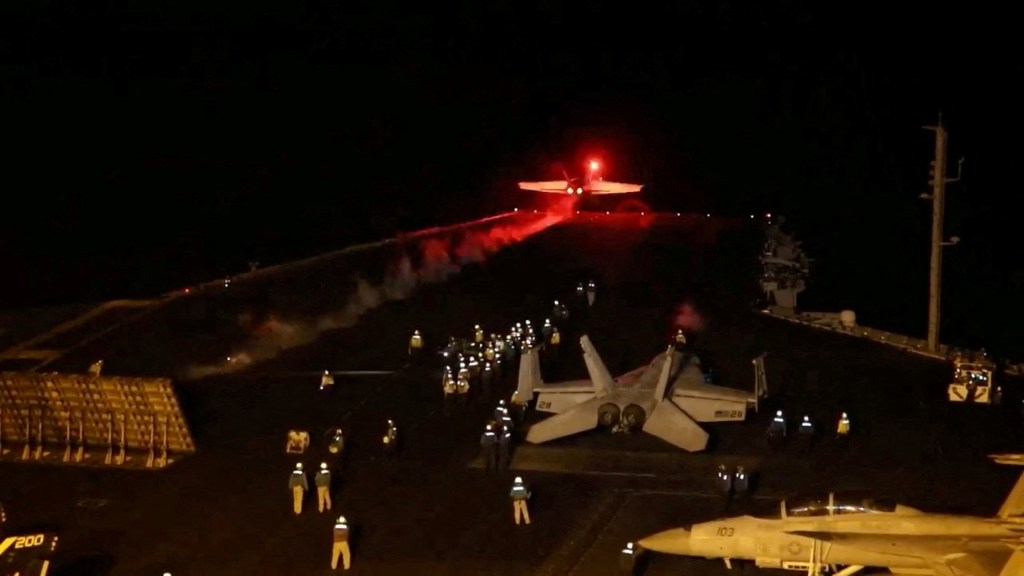
The U.S. and U.K. carried out a series of strikes targeting Houthi positions inside Yemen in order to deter the Houthi’s from attacking ships in the Red Sea.
A total of 73 strikes targeted 12 locations across Houthi-controlled areas, including the capital, Sana’a. The strikes resulted in five deaths, six injuries, and substantial damage to infrastructure.
The Houthi movement has been clear that it is attacking “Israeli”-linked vessels in the Red Sea in support of the oppressed people in Palestine, and that these actions will continue until the “Israeli” regime ends its aggression, blockade and occupation of Palestine.
The actions of the Houthi’s has had a considerable impact, causing the U.S. and its allies to take military action.
The Suez canal handles about 12% of global trade and is accessed by vessels travelling from Asia through the 30km wide Bab-el-Mandeb strait, which is located between Yemen and the Horn of Africa.
Since December 15, following a drone and ballistic missile attack on two merchant ships, four of the world’s largest shipping companies, accounting for over 50% of global container shipping capacity, have suspended their voyages through Bab al-Mandeb.
This escalation by the U.S. and U.K. against the Houthi’s highlight the following:
1. The Muslim Ummah has control of key geo-strategic locations that can be used against its opponents. The strategic importance of the Red Sea for the U.S. cannot be underestimated, as it heavily relies on its commercial ships and military fleets due to its geographic location. The Red Sea is considered a major passage for the movement of military fleets between the Mediterranean Sea, the Indian Ocean, Africa, and reaching China, Japan, and the Pacific Ocean.
In addition to the Bab al-Mandeb, Muslims control maritime navigation routes such as the Suez Canal, Hormuz, Dardanelles, and Gibraltar. However, it is the US-backed agent regimes who have surrendered the strategic advantage of these routes to the U.S.
2. The Houthi’s have demonstrated that it is possible for even a small, under-equipped militia to cause a substantial impact against the Western order. Whilst they are backed by Iran, which has its own agenda, the Houthi’s have won the hearts of many of the Muslims for their brave stance for the Palestinians against the occupying entity and its supporters.
On the other hand, Muslim regimes that have access to greater resources and stronger militaries have not only remained idle in the face of the atrocities in Palestine, but many have actively supported the occupying entity to overcome the Yemeni attacks in the Red Sea. The UAE, Saudi Arabia, and Jordan has been assisting “Israel” in getting around the Yemeni blockade by transporting foodstuffs across their borders headed to “Israel”. “Israel” is also operating a land bridge from the ports of Dubai as a replacement for voyages through the Red Sea, on a journey of about 2,000 km and two days through Jordan, in order to bypass the Houthis. In addition, many Gulf States, except Oman have opened up their airspace to allow the US and UK to carry out airstrikes against Yemen.
3. The U.S. and U.K. decision to launch airstrikes against Yemen demonstrates their complicity in the genocide against Gaza.
Whilst more than 30,000 Palestinians have been brutally murdered since October, and mass displacement and starvation of the remaining population, the U.S. and U.K. has continued to stand by its position of “Israel” having a right to defend itself and done nothing to stop the onslaught.
However, when it comes to the Houthi’s taking a stand against the occupying entity and doing what is in its powers to stop a genocide, killing no one but merely causing vessels to take an alternative route, the U.S. and U.K. decide to take military action against Yemen.
The West are portraying the Houthi’s in the same way they portray the resistance in Palestine, as a rag tag militia that has no support from the Muslims. However, the bravery of the Houthi’s to use its position to hit the West where it hurts has gained the support of the Ummah in a similar way to the resistance in Palestine.
The Ummah may be shackled and held back by the agent regimes placed in the seats of power, however Yemen has shown that Muslims possess the might and strength to face the U.S., the sole superpower of the world, and if Muslims united around a single authority, they would be able to defeat the colonialist occupiers and its defenders.

 Voice Of The Ummah
Leave a comment